Saturday, May 9, 2015

Phyllis Elaine Grieve Rosenberg, My Good Fairy


“If I had influence with the good fairy who is supposed to preside over the christening of all children, I should ask that her gift to each child in the world be a sense of wonder so indestructible that it would last throughout life, as an unfailing antidote against the boredom and disenchantment of later years--the alienation from the sources of our strength.”  Rachel Carson


Laurie and Phyllis, New York Botanical Garden, 1978

I owe most of my interest in education, culture, and the natural world to my mother, Phyllis Rosenberg, and her mother Tillie Grieve, both avid gardeners who nurtured my love of plants and nature.  Many of my friends from elementary school tell me they have a difficult time imagining me as a biologist and outdoors woman because back when they accompanied me on camping and outdoor adventures with our school class or Campfire group, it was definitely NOT my thing.  I was terrified of insects, liked my creature comforts and had a low tolerance for anything remotely “icky.”  However, early experiences with close family members planted seeds that would one day come to fruition.  Later on in life as I delved into the research literature that forms the foundation of my field—environmental education, I learned one of the key predictors of whether or not someone develops an interest in protecting the environment is if that person had a close relationship with someone who shared an enthusiasm for nature.  The combination of the emotional aspect of having a positive, uplifting relationship, and the mental stimulation that nature provides, makes these experiences capable of having deep lasting impact. 

I was blessed to have had a loving mother who cultivated a close relationship between the two of us.  She was a great friend, someone who was fun to be with, who had a joie de vive and was the most trusted of confidants.  When I was a girl, my mother regaled me with tales of growing up in Montague with seven aunts and one uncle.  Two of her aunts had big farms and she spent many happy summers with them.  A particular story that made an impression on me was her memory of the big draft horses they had with Christmas sleigh rides.  That sounded quite magical to me.  

Phyllis and a Friend, San Francisco, late 50's

She lived along the shores of Lake Michigan and when she visited my relatives out there we would take what seemed to me like long, long drives out to the beach and she told me she used to ride her bike on those roads to get there!  I loved the stories of her many girlfriends and their escapades at Cedar Lake Academy, the Adventist boarding school where she went to high school, and later her tales of many friends at Andrews University in Berrien Springs where she went to college.  


Mom told me about her early years as an English teacher in suburban Grand Rapids and Three Oaks.  She got her Masters in Library Science from the University of Michigan and went on to become a school librarian, first at the high school in St. Joe Michigan and later at Herbert Slater Jr. High in Santa Rosa California and Presidio Jr. High in San Francisco. 
 
My mom had many good friends from those days with whom she kept in contact.  Over the years whenever I met one of them, they reminded me my mother was quite a woman in her day, beautiful inside and out, sophisticated and a real go-getter.  

Phyllis was an adventurer and she spent a year teaching on a US Army Base in Tokyo Japan.  When I was a kid, she would bring her “Japan slides” to school or vacation bible camp or Campfire Girls meetings, and tell us all about what Japan was like.  I always joked that when mom flew back from Japan, her jet was followed by a small private one carrying all her goodies—silk kimonos, dolls, wood carvings, ivory, jade, china rice bowls and sake sets, fabrics, fans, wood block prints, watercolors, an ivory laughing Buddha and a porcelain Kon Yang, goddess of love, just to name a few.  How I loved sharing those things with my mom!  Her god-daughter Cathy Geha wrote me from Lebanon about the Japanese sandals and doll mom sent her and how envious her sister was.  Phyllis had exquisite taste and treasured and appreciated lovely things.
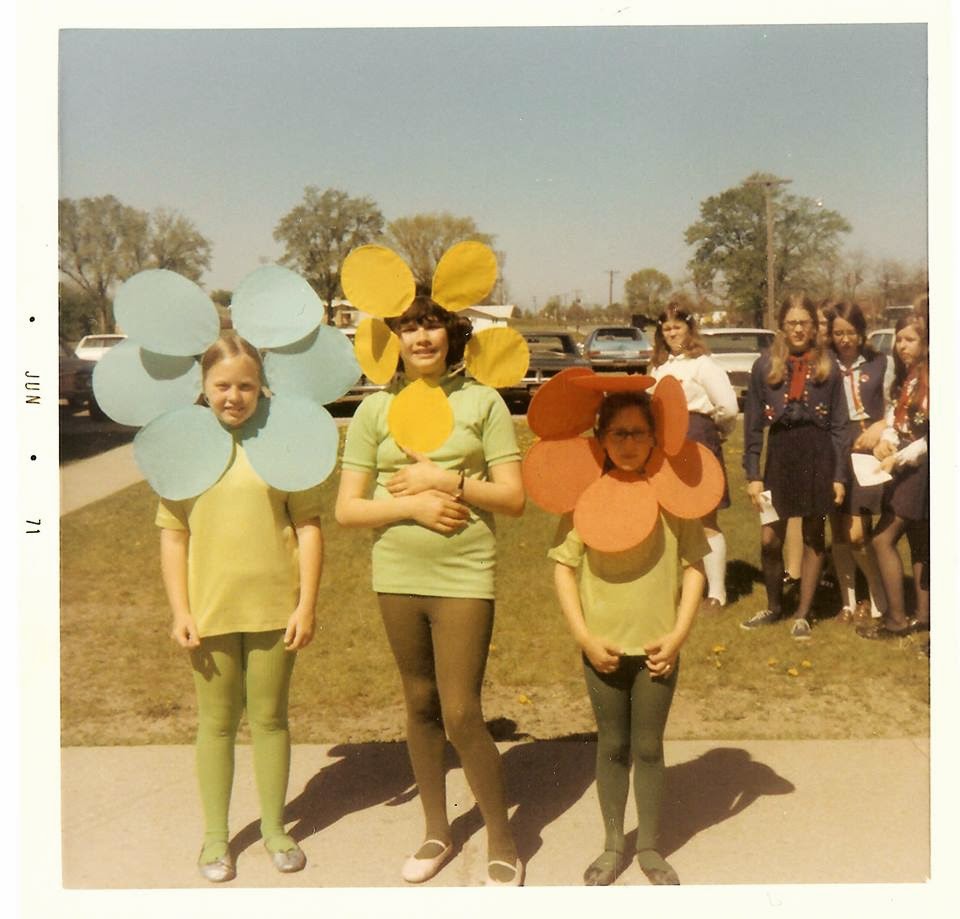
Later in my life, my mom was my partner in crime.  She taught me how to sew and do crewel embroidery.  She was a very creative soul.  I remember several epic Halloween outfits—fairy princess, witch, mother nature, and the year we tried to fashion a pumpkin frame out of wire.  I have a photo in my collection of Toni Arnold, Kay Jones and Linda Kourey wearing flower petal costumes with petals covered in tissue paper with their faces in the center, which she made for some spring play at Edison Elementary school.  All those Campfire Girl projects she led—making embroidered heart-shaped pin cushions, felt hangings, sewing my Indian princess gown, all those beads, and beads . . . the field trips to places like the State Capital and Kellogg factory.  Growing up, we were all blessed to have been surrounded by loving parents who worked hard to pull off these experiences for us!  For those of you whose parents are still alive and were your fairy godmothers and godfathers, give them a big hug for me, and if they’ve gone on to heaven, say a little thank you prayer.

Pookie and Belinda
And best for last, my mom shared with me the love of reading, which was the thing most near and dear to her heart.  I remember vividly mom reading to me, “Good Night Moon,” “Where the Wild Things Are,”, she gave me a copy of “The Giving Tree” one of our favorites, “Pookie” a story about a rabbit who runs away from home and tries his hand disastrously at being a fairy, until he is rescued by a wonderful kind woman named Belinda who sorta looked like my mom, “Paddle to the Sea” about a little carved Indian in a canoe that traveled the Great Lakes, a gift to us from mom’s friend Wanda, and then as I got older, reading aloud “My Father’s Dragon” and many others.  Then as I became an independent reader, she turned me on to Roald Dahl, (Willie Wonka), the Dr. Doolittle series, Mary Poppins, the Borrowers, Freaky Friday, Harriet the Spy, “A Wrinkle in Time” “Are You There God, It’s Me Laurie (I mean Margaret)” . . . OK I gotta stop, the list is too long!!  We wrote books in third grade and mom and some other mothers sewed them all together for us, and later as Coldwater librarian, mom helped organize a story writing contest as part of the book fairs at the elementary schools.

As a little girl encouraged by my mom, I devoured nature stories and made fairy gardens around the yard, thing I still do to this day.  I harvested and cooked fruits and vegetables from the garden with mom and grandma, did crafts using everything from sea shells to pressed leaves, collected pretty stones, went to see maple syrup being made and scooped up tadpoles to take back to a classroom aquarium.  I’m in my 50’s now, and yet those experiences still burn brightly in my memory.  

My mom expressed that she didn’t need people to come to the cemetery and “visit” her after she died, because she firmly believed she was NOT there.  She wanted to be remembered for the love she shared with us when she was alive, the wonderful times we spent together, and the effort she put forth to make a difference in her community.  Mom was raised a Seventh Day Adventist and they believe the body is the temple of the holy spirit, so we should take good care of this gift--not waste the treasure of life that we have been given.  My mom wanted to make the world a better place.  She was a firm believer that she had a guardian angel, and that’s what my mother was for me, MY guardian angel.  My confidence in guardian angels waxes and wanes, but I have come to realize that the world is filled with them--whenever we choose to engage in activities that “heal the world” and heal each other, we manifest  spiritual love into the material world and become each others angels.  This type of angel or fairy godmother or whatever you want to call it often shows up in my life.  To paraphrase the gist of Hebrews 13:2, “Do not forget to show kindness to strangers, for thereby some have entertained angels unawares.”  I learned that verse of course, from my mother.

Wednesday, February 4, 2015

Natural Dyes

Being a "plant person" most of my life, I've always enjoyed fiddling with plants for a useful project.  So natural dyes have been part of that fascination.  When one sees every color imaginable in nature's paintbox, it makes sense to want to capture it.  The problem with most plant-based dyes however, is that nature's palette fades.  The bloom is soon off the rose!  Plants produce their pigments for very specific, ephemeral purposes, there is no evolutionary incentive to expend the energy to make them last.  A flower's purpose is to attract pollinators, once that is accomplished, it's gone.  A fruit's purpose is to attract some animal to eat it and thereby spread the seed, and when that's done, it's done. Other pigments in plants help with light absorption and allow photosynthesis to take place under a variety of light conditions.  But the plant only expends the energy to make those pigments when it is doing photosynthesis, so those pigments aren't "light fast" meaning they degrade with exposure to light. Green chlorophyll fades the fastest, which is why as leaves die in the fall, the other colors emerge as the green fades.  But the yellows and reds and purples only last for a few weeks until they inevitably fade as well.
You can dye many things with plant pigments, but most of the dyes will fade over time.  Which is why before the advent of synthetic dyes, most people's clothing was rather drab.  Only the wealthy could afford the colors produced by labor-intensive gathering of certain natural pigments, like red produced from cochineal, tiny scale insects that grow on cactus in Mexico.  A few famous plants also produce reliable pigments such as indigo (blues and greens), madder (reds) and woad (blues and greens).  
Blootroot, Sanguinaria canadensis, courtesy of Elaine Haug, hosted by the USDA-NRCS PLANTS Database

In my North American Great Lakes woodland region, there are not many possibilities for vibrant, colorfast hues.  One example is the beautiful spring wildflower called "bloodroot" which is a threatened species so really shouldn't be harvested at this point.  It too fades with time.  

How to Prepare and Use Natural Dyes

Here is the link to a four page PDF tutorial on natural dying.  It includes information on how to gather and prepare the dye baths, and how to prepare cotton and wool for dying.  It also includes a list of locally available natural dye materials (if you live in the temperate zone in the US, that is!)  What I used for my dye baths is listed under the photos below.  These were thing I could easily find in my community in quantities sufficient to successfully dye enough product for some type of fabric project.  I chose dyestuffs that I had an inkling would work well.  Some were gathered from the Children's Garden at the Slayton Arboretum of Hillsdale College, some came from the local grocery store, and I got some at the wonderful Hillsdale Food Co-Op in their herb section.  You would have more luck if you were dying Easter eggs, as there are many vegetable pigments capable of producing vibrant colors that hold long enough to decorate the eggs and enjoy them over the Easter holiday.
LR: Henna, Blackberry, Turmeric
Top: Natural Wool Yarn
LR: Barberry (Inner bark), Black Walnut, Cherry Bark, Coreopsis mixed with Cosmos, Zinnia, Sunflower, Tansy and Marigold.

Below is a photo of those same dye materials on cotton.  As you can see, cotton does not pick up the dye nearly as well as wool.  The color variation in the blackberry/purple color is due to differences in the pH of the rinse water that got on that sample.  Henna on the cotton at the far right was almost a complete  bust but the dye-bath may have been exhausted by the time I did that sample. 

Stay tuned for my next blog with more on the chemistry of plant dyes! (Note: my mother died unexpectedly the day I finished writing this blog, and I have not been able to return to this topic since.)

 
And here is another set of colors on wool, from two years ago.


LR: Spinach and Fern, Beets, Turmeric, Tea


Wednesday, March 26, 2014

Local Business Highlight - Gleis Orchards

I was raised on locally grown Michigan produce, and it’s nice to know there is a nearby place where I can still get those high quality products.  Eating locally is easy when you can shop at a place like Gleis, just south of Jonesville Michigan.

I recently took my Hillsdale College Horticulture class to visit Gleis and meet with staff horticulturalist Chris Witschen.  We were eager to learn the ideas and practices that has kept this green business thriving for ninety-four years.  Chris described how he has stayed abreast of trends in the plant business throughout his career, which has spanned over 30 years. 

After going through a period of expansion during the mid 1980’s, the greenhouse business has had its ups and downs in Michigan, along with the general economy.  Chris explained the current market emphasis is on low-maintenance, high impact plants, such as wave petunias.  It is not as common these days as it once was to see people growing large flower beds and gardens, but there is a big demand for easy care plants and containerized plantings.  Chris described Gleis selection as a balance between the “bread and butter” items that everyone likes year in and year out, and new plant varieties coming from the breeders to appeal to people’s desire for something unique.  Gleis still provides perennials and more unusual plants for their loyal specialty-customers who often travel some distance every year to visit the nursery. 

Be Still My Heart!  :)
The consumer market’s diversity of interest is also reflected in the apple varieties grown in the orchard.  Most of Gleis customers buy a few types of popular apples, such as McIntosh, Fuji and Gala, and the regional darling Honeycrisp.  But Gleis carries over 30 varieties of apples, including the old favorite Northern Spy.  Chris said he had one customer who comes up from Indiana to the orchard every year to get this variety for her pies.

Another trend in plant sales Chris mentioned is an increased interest in home vegetable gardening, due to taste, economic and food safety concerns.  Gleis has started carrying more variety of vegetable plants in recent years.   They also grow vegetable crops to sell for their summer farm stand.  But there’s even more to love at Gleis!  You can find indoor potted plants and flower arrangements, as well as many food items including cheese, nuts, preserves and maples syrup.  They sell items to decorate your indoor and outdoor spaces for holidays too, including Christmas trees and pumpkins, Easter lilies and poinsettias.

When I asked Chris if Gleis had any interest in the organic movement, he emphasized his company uses a variety of non-chemical techniques for controlling pests, such as crop rotation and companion planting.  This is part of their integrated pest management philosophy.  It makes economic sense for them to use methods of crop management that prevent pest problems before they require a lot of chemical inputs.  He felt that USDA Organic certification was an impractical process due to many cumbersome hoops to jump through, such as the requirement that fields go without pesticides for three years before being awarded the certification.  That’s a difficult business model to follow and I have heard this complaint from many small growers over the years.  The policies and politics of “organic” in this country are a fascinating study, but that’s another article! Meanwhile, as I always say, best to seek out your local producers and get to know them and their practices.  They are usually happy to share!! 

Chris couldn’t give us any magical formula for his successes at Gleis, but he did emphasize keeping up with best practices and having a good soil formula and nutrient regime in the greenhouse, along with keeping records and following research through trade publications and professional networks.  He attributed much of his ability to manage things well to years of trial and error experiences.  We weren’t too long in Chris’ company before we realized why his colleagues call him the “Walking Encyclopedia!”  When it comes to keeping a small business running, there is no substitute for hard work and dedication and Chris Witschen embodies these principles!

Wednesday, March 12, 2014

Ms. Rose Makes Pink Applesauce!


Pink applesauce in jarsHaving recently returned to my home state of Michigan, I have become reacquainted with the wonderful variety of apples for which my agricultural powerhouse of a homeland is known.  At my local Meijers store, they label Michigan-grown apples, and there was one on the shelf I had not seen before, Ida Red.  My curiosity was piqued; I had heard it was a good pie apple, so I looked it up online.  One of the things I found out was you can make pink applesauce with this variety if you cook it with the peel!  If you know anything about me and my love of pink things, you know I had to give it a try!

The pesticide dilemma

Ida Red apple
Ida Red.  Isn't that the cutest apple!
The problem with using apple peel in applesauce is apples are one of the most pesticide-intensive produce crops out there.  They are at the top of the Environmental Working Group's list of the “Dirty Dozen” testing most heavily for pesticides.

Organically labeled apples cost more than conventionally grown ones, and variety is rather difficult to come by, so I usually circumvent problems by peeling the apples I eat.  But in this case I had to figure how to get rid of the pesticide residues, no easy matter.  That would be a great topic for another article, perhaps another day.  

There are many variables to consider if you want to go about cleaning apple peel in a scientifically proven effective way.  One problem is apples are coated with waxes in addition to having natural waxes on their skin.  Pesticides adhere to these waxes.  Also, many pesticides are waxy, and hard to remove with water.  If pesticides just washed off with water, they would be less effective because they would wash off when it rains.  Some pesticides do wash off this easily, some don’t.  You don’t necessarily know what pesticides any given apple producer is using--one reason to get to know your local farmers and buy from them, that way you can ask!  

Apples in soapy water
After doing some research, I decided to wash the apples in warm water with a mild natural soap, and then rinse them with water and follow that by a vinegar rinse to remove any possible soap residue.  Some sources will tell you soap isn’t necessary and it could add additional toxins to your apples.  While this is true for some washes, not sure it is true for all.  As far as I can tell that assertion isn’t backed up by any science, it's purely conjecture.  Pesticide removing washes haven't been widely studied.  Soap's chemical constituents will vary depending on what kind of soap you use, and eating a lot of soap might give you a stomach ache, but I have no reason to believe the chemicals in the soap I used are going to bio-accumulate in my body or wreak havoc with my immune system, unlike some pesticides.   I made the educated guess the tiny amount of soap chemicals that might adhere to an apple’s skin weren’t going to be a problem, but I hope to explore this topic more in a future post.  I used a natural soap with the non-toxic ingredients listed.  I scrubbed the apples with a brush, which is also recommended.  The ratio of vinegar I used for the rinse was 1 cup vinegar to three cups water.  I used apple cider vinegar.  I didn’t notice any soapy taste in the final product at all.  Here is a good link from Colorado State University Cooperative Extension on cleaning produce, with the standard recommendations, Guide to Washing Fresh Produce


The peel dilemma

Chopped apples in pot with peels

The second problem I encountered making this applesauce was removing the peel from the sauce.  The easy way to do this is to run the cooked applesauce through a food mill of some type.  The peels will get caught in the mill and pure sauce will come out the other end.  This is the standard efficient way to make applesauce,  since peeling apples wastes time and energy.  I have a Roma food mill but I don’t have access to it where I am right now, so I had to get creative.  I thought I could peel the apples, leave the peel in big pieces, and then fish it out later.  I didn’t realize the peel would cook down significantly, so the task of fishing out the peels was very fussy.  Also, a lot of sauce adheres to the peel.  After fishing out the biggest pieces, I ran the peel through a sieve to extract most of the sauce.  There were a few small bits of peel in the sauce but sans the pesticide load, that’s good for ya!  I was reminded of my Baubie’s homemade applesauce which often had bits of peel in it.  I didn’t like that as a kid but now it brings back a wave of nostalgia for Baubie’s old kitchen and Baubie’s old arthritic hands somehow still managing to make yummy homemade applesauce and homemade noodles.  I always feel connected to her when I make applesauce like she did so long ago.Applesauce in pan
 

The taste dilemma

Pink applesauce in white bowlSo here’s the finished results.  Not so much pink as a very pale peachy color.  As far as taste, not my all- time favorite, rather mild.  I have found that when it comes to apples, taste is very subjective.  My mom likes mild applesauce made with soft McIntosh, she thinks that kind tastes most traditional and has the best texture.  Dad and I like spicier, chunkier applesauce.  My go-to apple for sauce is Golden Delicious.  Many folks swear by a mix of apples, some tart, some sweet.  I recently made a batch of applesauce that was a mix of Jonagolds and Empire, which are themselves crosses between Jonathan and Golden Delicious, and Red Delicious and McIntosh.  Best of both worlds, it was a hit with everyone in the family.

Just for fun, you might try checking out this Web site, “Orange Pippen,” where folks post reviews of various apple varieties.  You might find yourself spending a good bit of time reading the fascinating range of opinions!